What earns the 7.9.
Five equally weighted categories assess documented equipment and buyer fit. No measured speed, handling, durability, runtime or reliability scores are assigned.
Build / buyer fit
8.5/10White panels and documented beginner assembly reduce the clear-shell finishing stage.
Documented equipment
8.0/10Supplied brushed motor, export ESC and CVA dampers form a coherent starting package.
Setup / adjustment
8.0/10Two wheelbases offer a meaningful documented mechanical choice.
Service understanding
7.5/10Cage/driver battery access is explained; instruction correction must accompany the manual.
Complete-purchase value
7.5/10Missing radio and power equipment need a real quote, but the stock motor need not be replaced.
The buying case: Fighter NXGEN DT-04
The Fighter NXGEN is a sensible complete-car kit for a new builder who wants a contemporary beginner buggy, particularly when a local club can explain its beginner class. The DT-04 gives you independent suspension, oil dampers, a supplied brushed motor and a distinctive single-seater body without starting from a bare chassis. Its main reservation is that racing eligibility and the completion electronics still need to be checked. A name associated with beginner racing is useful context, not a universal entry pass.
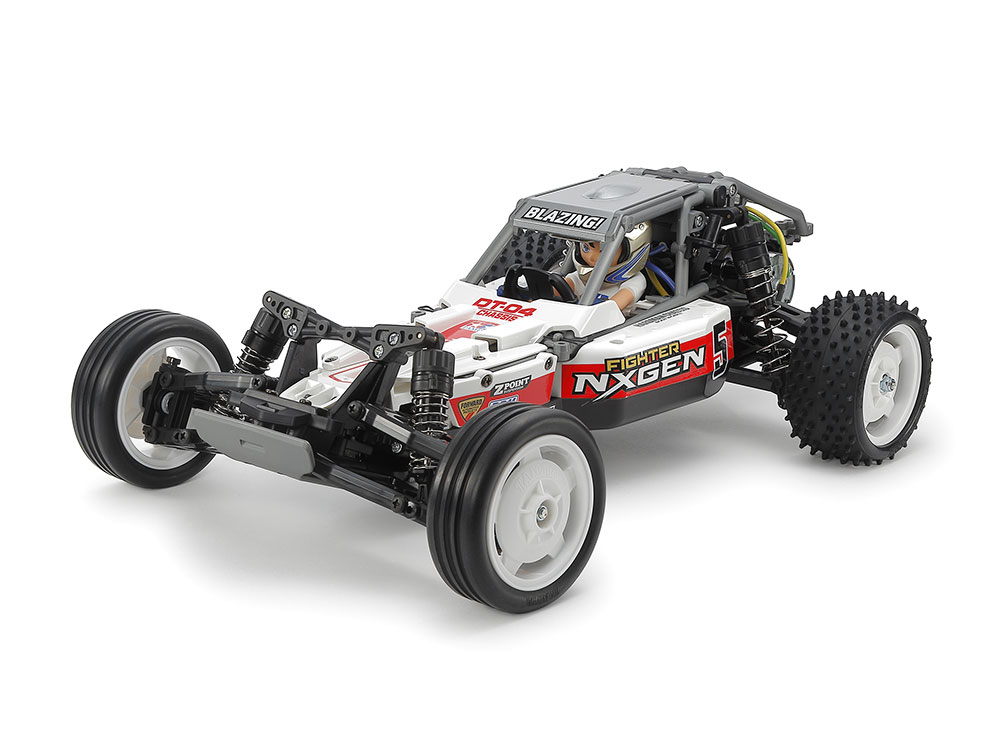
Our exact model is 58741, verified by Amazon under that same part number. The body-inclusive kit is an assembly project rather than an RTR. Its white molded body panels reduce the clear-shell painting job, but you still assemble the running gear, install radio equipment, set the steering and charge a compatible pack. The finished official photographs show how it can look after those stages.
I would shortlist this over an older nostalgia buggy when the first objective is learning a conventional functional build. The two wheelbase configurations give it a real adjustment to explore after you have established a baseline. We have not driven either configuration, so the review does not promise a handling difference beyond reporting the manufacturer’s intended distinction. The editorial score concerns the documented equipment and fit for a beginner who expects to do the assembly.
Sources: Manufacturer ↗ · Manufacturer manual / specification ↗
The complete package: Fighter NXGEN DT-04
The supplied motor is a 540-size brushed unit; Tamiya USA identifies it as Torque Tuned and names a Hobbywing-produced brushed ESC. The global English page says an ESC is included for export while also retaining a generic radio-with-ESC requirement. The Amazon listing identifies an export kit containing a controller and motor. Those statements support treating the offered package as an equipped export kit, while leaving the exact ESC identity to the current box if the seller’s regional specification differs.
You need a two-channel transmitter and matching receiver, a standard-size steering servo, suitable drive pack, charger, transmitter cells and assembly tools. Paint for the driver figure is separate. Tamiya warns that low-profile servos can fail to fit depending on their shape; that is the opposite of the BBX’s low-profile requirement. Do not move a servo recommendation from one scale-buggy review to the other simply because the bodies look related.
Plan the build around the motor and gearbox, dampers and front assembly before adding the body panels. There is an instruction correction referenced by Tamiya USA for page 26, so obtain the current manual and correction together. A beginner is better served by a clear sequence and a tidy hardware tray than by assembling everything rapidly and then guessing which fastener was misplaced. The kit’s accessibility does not remove the need to inspect each completed stage.
Sources: Manufacturer ↗ · Manufacturer manual / specification ↗
Drivetrain and power: Fighter NXGEN DT-04
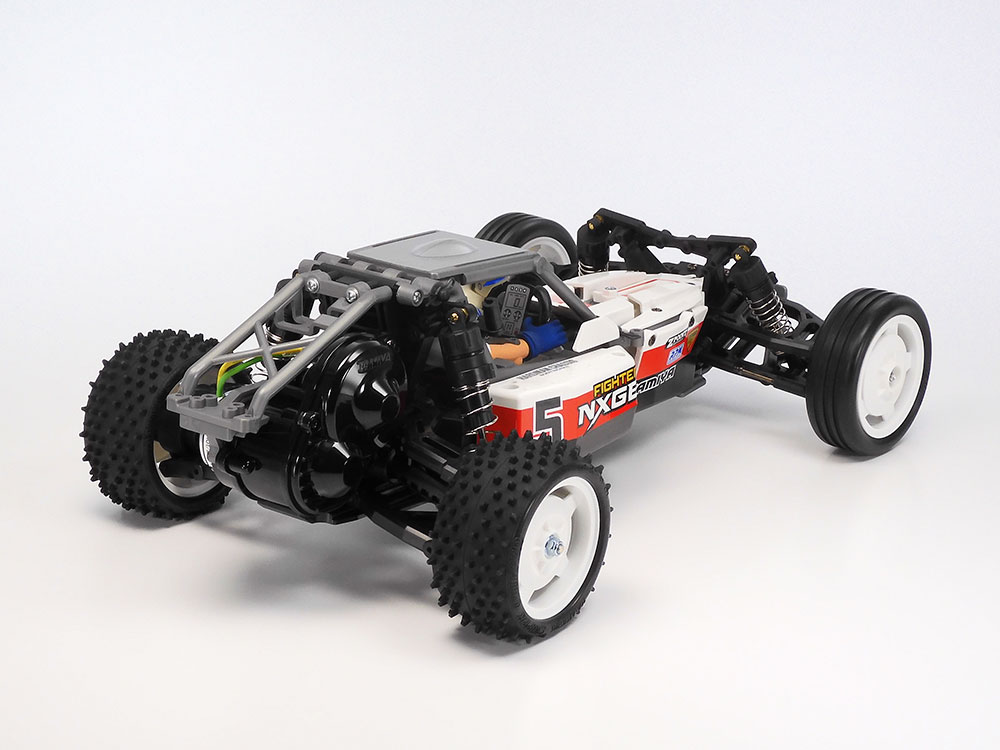
The DT-04 puts the battery lengthwise and the motor at the back, driving the rear wheels through a sealed gearbox and three-bevel gear differential. This is a conventional rear-drive buggy brief rather than a miniature crawler. The manufacturer lists a 9.28:1 stock ratio. That ratio explains the installed gear arrangement; without a specified pack and actual test it does not establish a top-speed figure.
Follow the gearbox instructions and confirm free rotation before closing the housing. The differential should do its intended job of permitting different wheel speeds through a turn. An unevenly assembled transmission or binding axle can draw unnecessary current and disguise itself as poor motor performance. A more powerful replacement motor would not fix either problem. For a first build, I would keep the Torque Tuned motor and learn how the complete stock installation behaves on an appropriate surface.
The controller’s electrical capability should not become a blanket recommendation to fit any pack its label might accept. The US completion guidance specifies 7.2–7.4 V equipment, and the offered Amazon export package describes a 7.2 V NiMH route. Use the actual ESC instructions and model guidance together when selecting chemistry, voltage and connector. A listed 2–3S controller capability describes the electronics, not independent evidence that 3S is a sensible standard DT-04 purchase. A coherent documented baseline is worth more than an ambitious voltage choice.
Sources: Manufacturer ↗ · Manufacturer manual / specification ↗
Radio and setup: Fighter NXGEN DT-04
The radio is your choice, which is an opportunity to buy usable steering and throttle adjustments without claiming that a transmitter is supplied. Count the receiver, servo and transmitter cells in the completion basket. If you already have a radio, verify protocol compatibility and available receiver channels before placing an order. The car cannot use an unrelated spare receiver simply because its plugs resemble the ones on your existing equipment.
Center the servo before fitting the horn, then connect the three-piece steering arrangement as the manual shows. Calibrate the chosen or supplied controller, check motor direction, and make the first power-on with the rear wheels safely raised. A restrained throttle setting on a suitable radio can be useful for the first session, but the kit itself does not supply a named electronic beginner mode or gyro. Those choices depend on the electronics fitted by the builder.
Greg Vogel’s RC Driver coverage identifies the exact 58741 and walks through the box and build highlights. That gives attributable independent context about the beginner-kit project. It is not our test, and the historical $154 figure in that coverage is not substituted for a current offer. The useful takeaway for shopping is that the radio, servo, pack and charger are real separate decisions. Resolve them as a complete installation instead of letting an attractive kit price hide the final control-system work.
Sources: Manufacturer ↗ · Manufacturer manual / specification ↗ · Independent coverage ↗
Steering and suspension: Fighter NXGEN DT-04
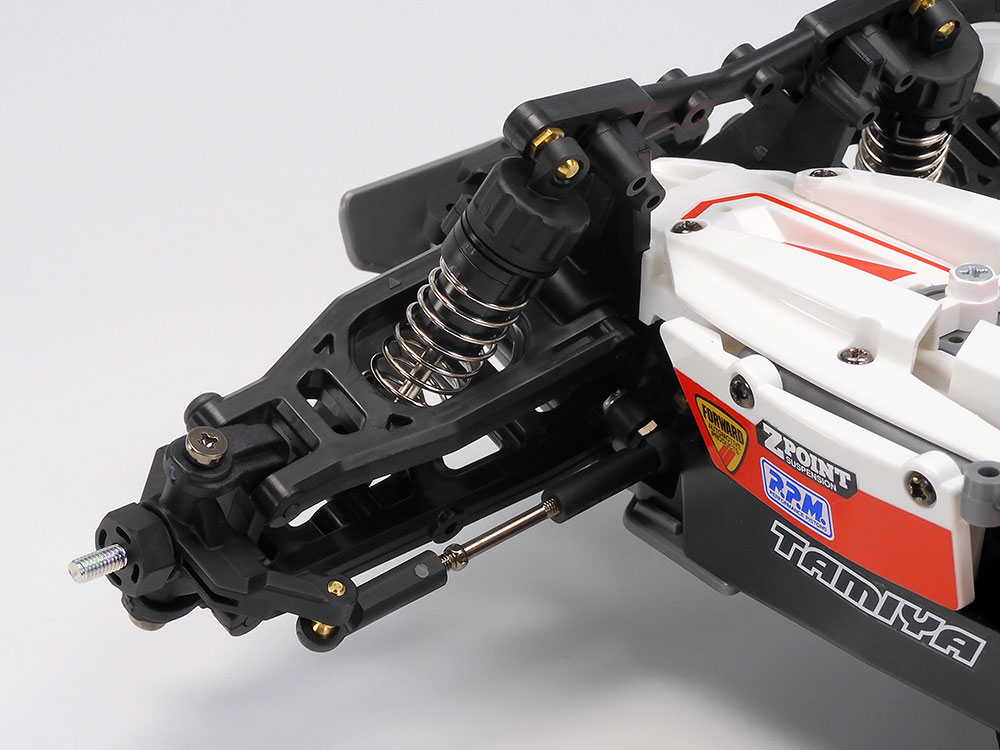
Four-wheel independent double-wishbone suspension and CVA oil dampers form the core beginner-equipment case. The long front arms, turnbuckle steering links and three-piece steering layout give you conventional mechanical features to learn. Assemble the dampers consistently, check suspension motion without the servo pulling on it, and compare both sides before selecting adjustment changes. A stiff pivot can create inconsistent motion regardless of the shock oil you choose.
The two wheelbases are 265 and 280 mm, obtained by reassembling the front section. They are not an electronic switch or a free change made while the battery is charging. Tamiya presents the shorter setup as favoring handling and the longer one as favoring stability. We report that intent without claiming a measured improvement. Keep the initial configuration noted and alter it as a separate workshop operation after enough driving to know what you are trying to change.
Begin steering setup with correct servo fit and neutral alignment. Check the saver, linkage and endpoints for binding, and recheck them after a wheelbase change. The front skid angle is listed as 22.5 degrees, a fixed geometry feature that contributes to the buggy arrangement. It is not a reason to promise that the car can clear every obstacle. The buyer benefit is understandable suspension and meaningful setup work, with a standard-size servo requirement that needs to be followed rather than guessed from another Tamiya model.
Sources: Manufacturer ↗ · Manufacturer manual / specification ↗
Where to drive: Fighter NXGEN DT-04
The ribbed front tires and square-spike rears establish an off-road buggy package. Begin on compact dirt or another comparatively even practice surface where the driver can see the car and avoid obstructions. Long grass, rough rocks and sharp pavement edges are different problems from the undulations a buggy suspension is intended to address. A first session is more useful when it verifies assembly than when it demands an immediate demonstration of maximum obstacle clearance.
For beginner racing, ask the venue about permitted motor, battery, tires and hop-ups before building a competition shopping list. The Fighter name and its German beginner-racing background are meaningful context, but local rules may differ. Tire choice can dominate that preparation. It would be wasteful to glue or fit an optional set solely because a video uses it and then discover that your intended class requires something else.
Run short initial checks and stop to inspect the gearbox, wheels, shock attachment and steering. The model’s sealed transmission helps protect its internal mechanism, but the battery area and suspension remain exposed to debris. Clear dirt around the moving parts before it becomes a reason for inconsistent action. We have not established waterproof operation for the whole regional electronics installation, so use the actual manuals. A dry, controlled practice route gives a beginner clearer feedback and makes the first maintenance inspection easier to perform.
Sources: Manufacturer ↗ · Manufacturer manual / specification ↗
Body and service: Fighter NXGEN DT-04
The white injection-molded panel body is a particularly useful feature for somebody who finds a clear shell intimidating. Tamiya describes separate screw-attached panels, a driver figure and two marking schemes. You can assemble the body without painting the main white panels, then add the chosen stickers and finish the driver separately. That reduces one kind of first-build workload without removing the satisfaction of creating the finished model.
Battery access involves lifting the cage and removing the driver arrangement as instructed. Rehearse that operation before fixing receiver and controller wires nearby. A tidy battery connection should not pull on the servo lead every time the pack is changed. The panel mounts also deserve a gentle approach: tighten fasteners appropriately and preserve the parts rather than treating them like a metal roll cage.
The sources contain an important dimensional disagreement. The US page gives 385 or 395 mm length depending on wheelbase, 248 mm width and 120 mm height; the global/Japan specification gives a 395 mm example with 245 mm width and 125 mm height. This review flags the differences and retains the wheelbase options as the reliable purchase distinction. Do not order an exact molded transport insert from a silently combined table. For ordinary shelf planning, the body-inclusive 1/10 buggy footprint is clear; for a close fit, measure your completed configuration.
Sources: Manufacturer ↗ · Manufacturer manual / specification ↗
Startup basket: Fighter NXGEN DT-04
The dated Tamiya USA manufacturer MSRP reference is $227 for the kit. The exact Amazon link supplies a separate place to check a current seller offer, which remains independent of the article’s reference price. Confirm the included export controller and price the radio, servo and power equipment before comparing a complete purchase. Historical video prices describe another period and are not current startup totals. The standard motor and molded body reduce particular completion tasks, but neither the manufacturer reference nor a temporary seller price pays for all the missing equipment.
The startup basket consists of 58741, transmitter and receiver, standard-size steering servo, appropriate 7.2–7.4 V drive battery, matching charger, transmitter cells, tools and driver paint. The export ESC and supplied motor are part of the documented kit case. If a particular box differs, resolve that before ordering so that the completion list can be revised. We do not have current prices for every chosen extra, so the basket is complete as a list but has no fabricated dollar subtotal.
Optional bearings, suspension settings and cosmetic parts are separate from getting a stock car running. The US table lists plastic bushings, so bearings may be a considered build-time purchase, but they are not represented as included simply because another Tamiya buggy has them. Ask the class organizer before adding competition options. I would spend first on compatible controls and charging equipment, then learn the standard chassis. That keeps the first budget related to actual use rather than an untested list of upgrades.
| Item | Included / extra | Price basis |
|---|---|---|
| Reviewed vehicle | Kit/car only | $227.00 · stated dated reference |
| Motor | 540 Torque Tuned brushed · supplied export kit | Included/extra as described |
| ESC | Export includes ESC; US specifies Hobbywing THW1060 | Confirm regional box; price any missing controller separately |
| Radio / servo | 2-channel radio/receiver + STANDARD-SIZE servo · extra | Extra; quote exact components |
| Drive power | Suitable 7.2–7.4 V pack/charger · extra | Extra; quote exact pack and charger |
| Tools / finishing / transmitter cells | As required by exact manuals | Price required items separately |
Sources: Manufacturer ↗ · Manufacturer manual / specification ↗ · Manufacturer price reference ↗
Real alternatives: Fighter NXGEN DT-04
The BBX is a complete body-inclusive scale-buggy kit for the buyer who wants a more involved mechanical project and accepts a separate motor purchase. It uses a ball differential, aluminum dampers and a different servo fit requirement. It is worth comparing when detail and assembly interest are more important than the shortest beginner build. Its more elaborate equipment does not supply a tested race advantage in this review.
The Neo Fighter DT-03 is a complete-car kit to investigate if an established beginner class or local support favors that platform. Confirm the exact body-inclusive box, motor and controller before comparing prices. The DT-04 inherits some running hardware from earlier DT chassis, but that does not make every part or setup instruction interchangeable. A club familiar with one platform can be more valuable than a feature you will not know how to adjust.
The Grasshopper II is the alternative for a simple nostalgic project with a molded body and supplied smaller motor. Choose it when that old-style construction is the attraction, rather than because the kit price looks low. Its friction damping and rolling rear assembly describe a different starting point. I would choose the Fighter NXGEN for the beginner who wants oil dampers and independent suspension in a current project, the BBX for a more ambitious scale build, and a club-supported DT-03 when the local advice and rules give it a concrete advantage.
Sources: Manufacturer ↗ · Manufacturer manual / specification ↗
Buying verdict: Fighter NXGEN DT-04
The Fighter NXGEN’s case rests on useful beginner equipment and a body that avoids an obligatory clear-shell painting stage. The supplied motor, export controller, independent suspension, CVA dampers and wheelbase choices form a coherent complete-kit project. The reservations are the remaining electronics basket, regional documentation differences and the need to check beginner-class rules rather than assuming eligibility from a name.
Our five categories assess build accessibility, supplied running equipment, documented adjustment range, service planning and completion value for a newcomer considering beginner racing. We do not score measured handling, speed, impact tolerance or reliability. Greg Vogel’s exact-model build coverage supports the workshop context; its experience remains his, and its old price remains old. The manufacturer dimensional conflict is retained rather than converted into a false precise specification.
I would buy the DT-04 for a patient beginner who wants to learn suspension and radio setup, especially with local help. Choose the standard motor, an appropriate servo and compatible battery route, follow the instruction correction, and document the first wheelbase setup before experimenting. I would pass if the need is immediate RTR driving or a competition class built around another platform. For the intended builder, this is a credible first buggy with enough mechanical substance to keep the second workshop session interesting after the first assembly is done.
Know exactly what you’re ordering.
Published manufacturer specifications for model 58741. Conflicting figures are flagged rather than silently corrected.
| Exact model / SKU | Tamiya 58741 |
|---|---|
| Amazon ASIN | B0DWDQZW5D · API verified |
| Scale / drivetrain | 1/10 · RWD |
| Purchase format | Body-inclusive assembly kit |
| Motor | 540 Torque Tuned brushed · supplied export kit |
| Speed controller | Export includes ESC; US specifies Hobbywing THW1060 |
| Radio / steering servo | 2-channel radio/receiver + STANDARD-SIZE servo · extra |
| Drive battery / charging | Suitable 7.2–7.4 V pack/charger · extra |
| Length / width / height | US 385/395 × 248 × 120; global example 395 × 245 × 125 mm |
| Wheelbase | 265 or 280 mm · front-section reassembly required |
| Suspension | Four independent double wishbones with CVA oil dampers |
| Tires / wheels | Front ribbed 27/80; rear square-spike 41/86 mm |
| Gear arrangement | 9.28:1 · manufacturer stock |
| Body | White molded panels and driver; supplied |
| Specification caveat | US/global dimensions conflict. Export ESC included while generic requirements retain ESC wording. Follow page-26 correction. |
Sources: Manufacturer ↗
The questions worth asking.
Does this exact model come ready to run?
No. It is a body-inclusive assembly kit. The body and chassis are supplied, but assembly, finishing and completion electronics remain part of the purchase.
What motor and controller are included?
540 Torque Tuned brushed · supplied export kit. Export includes ESC; US specifies Hobbywing THW1060. Confirm the offered regional box before buying replacement electronics.
What do I need for the first session?
2-channel radio/receiver + STANDARD-SIZE servo · extra. Suitable 7.2–7.4 V pack/charger · extra. Transmitter cells, appropriate finishing materials and assembly tools also need checking.
What ground should I plan to use?
The ribbed front tires and square-spike rears establish an off-road buggy package. Begin on compact dirt or another comparatively even practice surface where the driver can see the car and avoid obstructions. Long grass, rough rocks and sharp pavement edges are different problems from the undulations a buggy suspension is intended to address. A first session is more useful when it verifies assembly than when it demands an immediate demonstration of maximum obstacle clearance.
Which specification differences should I check before ordering?
US/global dimensions conflict. Export ESC included while generic requirements retain ESC wording. Follow page-26 correction.
Is the editorial rating a driving test or Amazon star rating?
Neither. It evaluates the documented complete purchase for new builder considering beginner buggy racing. Manufacturer facts, API identity and independent context are credited separately. No speed, grip, crash or reliability measurements are invented.
How this review was researched.
Manufacturer documentation establishes the mechanism and requirements. Amazon Creators API verifies the exact listing/part number and dated offer. RC Driver · Greg Vogel exact Fighter NXGEN build video supplies attributed context; any modified build or sibling variant is explicitly distinguished in the article. US/global dimensions conflict. Export ESC included while generic requirements retain ESC wording. Follow page-26 correction. Manufacturer US published MSRP is a dated vehicle-only reference; the live Amazon offer remains separate.
Research-led buying assessment using exact manufacturer documentation, verified Amazon identity and attributable independent coverage. We have not physically driven this model.
- Tamiya · exact model product/specification ↗Manufacturer · checked 13 Oct 2026
- Tamiya · assembly/body or regional specification documentation ↗Manufacturer manual / specification · checked 13 Oct 2026
- Amazon Creators API · exact ASIN B0DWDQZW5D ↗API product verification · checked 13 Oct 2026
- RC Driver · Greg Vogel exact Fighter NXGEN build video ↗Independent coverage · checked 13 Oct 2026
- Tamiya US manufacturer MSRP reference · kit only ↗Manufacturer price reference · checked 13 Oct 2026
13 October 2026: original complete-car research review, exact API identity, current evidence ledger and credited manufacturer media.
THE GARAGE EDITOR’S CALL
A considered purchase for new builder considering beginner buggy racing
I would buy the DT-04 for a patient beginner who wants to learn suspension and radio setup, especially with local help. Choose the standard motor, an appropriate servo and compatible battery route, follow the instruction correction, and document the first wheelbase setup before experimenting. I would pass if the need is immediate RTR driving or a competition class built around another platform. For the intended builder, this is a credible first buggy with enough mechanical substance to keep the second workshop session interesting after the first assembly is done.
Check exact car on Amazon ↗