What earns the 8.0.
Five equally weighted categories assess documented equipment and buyer fit. No measured speed, handling, durability, runtime or reliability scores are assigned.
Build / buyer fit
9.0/10Cage, separate panels, ball differential and dampers make a substantial model-building project.
Documented equipment
8.5/10Six-panel body, driver and nets provide coherent single-seater presentation.
Setup / adjustment
8.5/10Bearings, universals and aluminum dampers are documented stock equipment.
Service understanding
8.0/10Liftable rear cage and nose access provide defined service operations.
Complete-purchase value
6.0/10Motor, ESC, low-profile servo and power equipment all need separate prices and compatibility checks.
The buying case: BBX BB-01
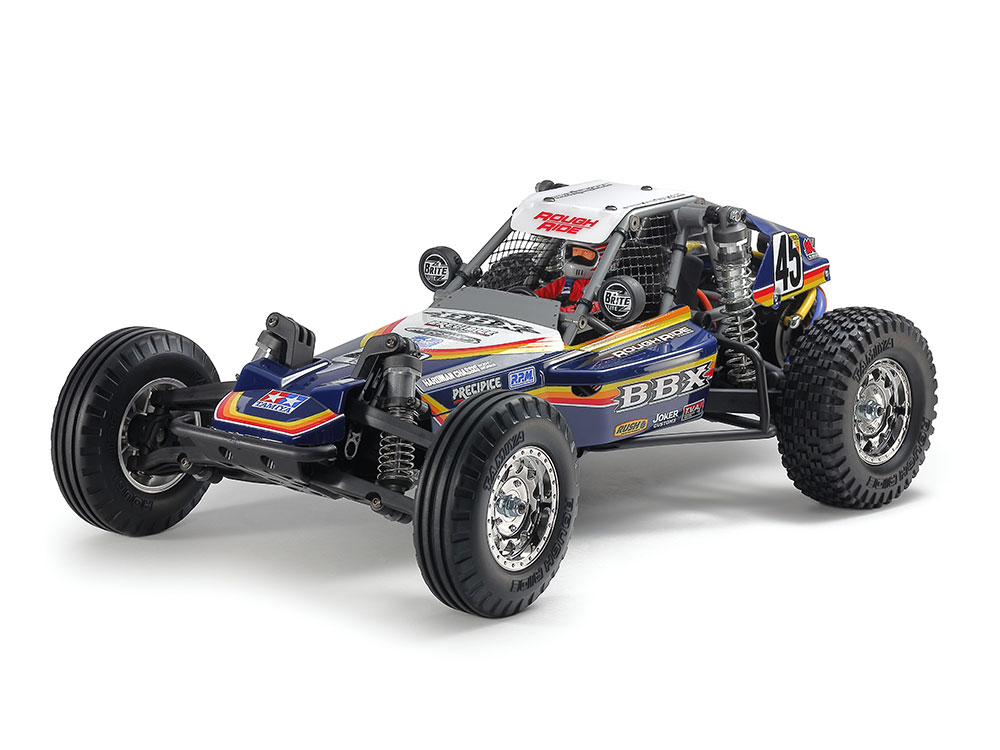
The BBX is the Tamiya buggy I would choose for an experienced modeler who wants the build to feel like a miniature off-road vehicle rather than simply assembling a motor and four wheels. Its cage, separate panels, driver, nets and long-travel-looking suspension form a coherent scale project. The reservation is completion cost and component selection. This kit does not supply a motor, speed controller, radio or steering servo, and there are meaningful fit requirements that deserve attention before an electronics order.
Our exact subject is 58719 on the BB-01 chassis, with Amazon’s part number also 58719. The body panels are included, so it is a complete vehicle kit, not a bare BB-01 frame or an option-parts package. It is not an RTR. Expect to assemble the running hardware, finish the panels and figure, fit electronics and carry out control setup. The factory photographs show what a completed and finished example can look like.
The BBX’s strongest buyer case is someone who wants modern mechanical interest and vintage single-seater style in the same workshop project. A first-time builder could work through it carefully, but should not mistake its excellent appearance for the shortest route to a running buggy. We assess the documented purchase and assembly requirements, not its top speed, suspension efficiency or crash resistance. Those would need actual testing and a stated electronics configuration.
Sources: Manufacturer ↗ · Manufacturer manual / specification ↗
The complete package: BBX BB-01
The kit supplies its cage and panel body, driver, wheels, tires, suspension, gearbox components and ball-bearing running hardware. Separately required equipment includes an appropriate 540-size motor, compatible ESC, radio with receiver, low-profile steering servo, drive battery, charger and transmitter cells. Paint and assembly tools complete the list. A conventional standard-height servo already in a spares box is not automatically useful here; the cage and steering installation define the available space.
The motor shaft requirement is unusually specific. Tamiya asks for more than 10.5 mm of usable shaft where the pinion attaches and warns that certain familiar motors are unsuitable. That means choosing by motor size or turn count alone is insufficient. Check the shaft specification and fit instructions before ordering, particularly if you intend to use an existing motor. A bargain unit that cannot accept the pinion in the correct location does not complete the car.
I would obtain the manual before buying electronics, write down the servo dimensions and shaft requirement, then match those with actual parts. Stage the gearbox and damper assembly across a clean work surface; they deserve more concentration than applying the body stickers. Keep the six panels separately labeled while trimming and painting. This is a kit with enough construction detail to justify a deliberate build, and it rewards planning much more than a rushed collection of individually attractive components.
Sources: Manufacturer ↗ · Manufacturer manual / specification ↗
Drivetrain and power: BBX BB-01
The BB-01 uses rear-wheel drive, a sealed gearbox and a ball differential. Tamiya’s official description identifies that differential, while the matching Amazon feature text incorrectly calls it an oil-filled gear differential. We follow the manufacturer and retain the API conflict in the evidence note. Amazon verifies the listing’s identity and offer; it is not the final engineering authority when a bullet conflicts with the actual manufacturer documentation.
A ball differential is an assembly and adjustment task, not simply a gear box you pack with whatever lubricant happens to be nearby. Follow the specified lubricant, build sequence and tightening procedure. Check the resulting action before connecting a motor. The supplied 18-tooth pinion gives a listed 12.42:1 ratio; treat that as a starting configuration, not a top-speed estimate. The chosen motor, battery and final build will influence operating behavior.
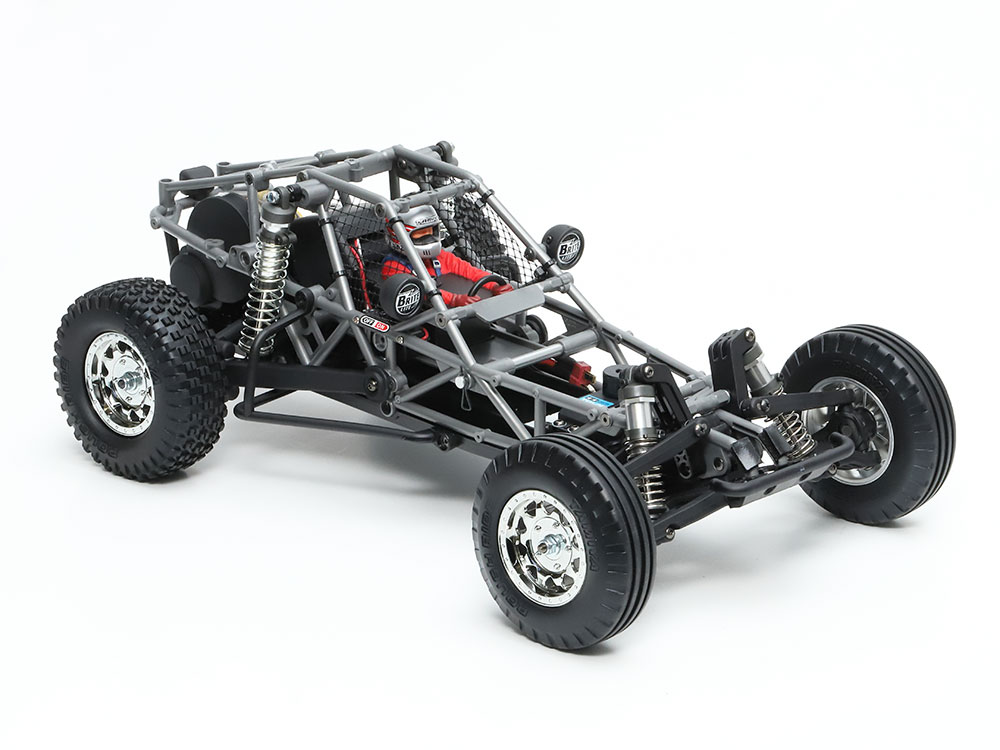
Tamiya lists universal rear driveshafts and a rear-mounted motor. The latter remains accessible beneath a liftable section of the cage, which makes future inspection or motor replacement more understandable. It does not remove the need to check shaft clearance, gear mesh and wiring. I would finish the standard transmission before considering more power. Because the kit supplies no motor, you can choose a coherent system from the outset, but the freedom to choose still has to respect the shaft requirement and the controller’s electrical limits.
Sources: Manufacturer ↗ · Manufacturer manual / specification ↗
Radio and setup: BBX BB-01
There is no factory radio or gyro in the BBX purchase. Pick a transmitter and compatible receiver that offer the adjustment you actually need, then place the receiver, ESC and cables in the chassis before fixing them down. Space inside a scale cage is valuable. A clean installation should let you disconnect the battery, remove the appropriate panel and access the motor without repeatedly dragging leads across the suspension.
RC Driver’s Peter Vieira highlights the angled steering bellcranks and detailed assembly features in his BBX build preview. That is independent workshop context, not our hands-on experience. It supports the editorial conclusion that there is worthwhile mechanical work here, but does not establish a measured steering advantage. Similarly, a separately cited sponsored RC Driver modification article is useful for photographed access and construction; its upgrade enthusiasm is not an independent requirement to buy every hop-up.
Center the low-profile servo before connecting its saver and linkage. Use the selected radio and ESC manuals for neutral settings, reverse direction, calibration and battery chemistry configuration. Keep the rear wheels clear during the first powered check. If a power system includes braking or throttle response adjustments, begin with the controller’s documented baseline and alter one setting after observing the car. The BBX’s attractive detail is a reason to make the installation tidy, not a reason to hide uncertain control setup beneath finished panels.
Sources: Manufacturer ↗ · Manufacturer manual / specification ↗ · Independent coverage ↗
Steering and suspension: BBX BB-01
The front suspension has double wishbones with a 25-degree skid angle, while the back uses trailing arms. Aluminum cylinder aeration oil dampers are supplied at all four wheels. Those are useful documented differences from the simpler Hornet and Grasshopper layouts. They give the builder a more involved suspension project, but this research does not turn those component names into quantified bump handling or grip claims.
Take time over the damper instructions. Match left and right assembly, compare travel and make sure the suspension moves freely before connecting the steering servo. The aeration arrangement is not a reason to use an arbitrary shock-filling process copied from another car. A familiar-looking damper can still have a different intended build. The rear alignment options likewise deserve a written baseline so that later changes can be reversed.
A low-profile servo is required for the stock steering space. A powerful standard-height unit can be the wrong choice even if its advertised torque is impressive. After centering the servo, check the saver and three-piece tie-rod assembly through full movement, then set transmitter endpoints to avoid forcing a stop. Check again with the body panels fitted. I would prioritize free motion and appropriate travel over maximum servo specification. Steering that binds inside an accurately detailed cage is still a setup problem, and no electronic setting can manufacture the missing physical clearance.
Sources: Manufacturer ↗ · Manufacturer manual / specification ↗
Where to drive: BBX BB-01
The BBX is an off-road buggy with ribbed front tires and square-spike rear tires. The manufacturer lists roughly 92 mm front and 96 mm rear diameter, which gives the tires a scale-buggy presence without making them crawler tires. Compact dirt and relatively even off-road practice space are sensible first choices. Tall grass, rock gardens and repeated large jumps should not be inferred from the body’s resemblance to a full-size desert racer.
Start on a surface that lets you check the build. Run gently, stop and inspect the transmission, wheel attachments and suspension before extending the session. Because buyers choose different motors and packs, a universal runtime or top speed would be particularly misleading here. If something feels inconsistent, return to the same patch of ground with the same equipment before deciding an alignment change is responsible. Your own baseline observations will be more useful than somebody else’s video of a different electronics build.
The cage and low panels also create places for dirt to collect. Remove the appropriate cover and inspect the battery tray, steering rack and exposed links after a dusty outing. Clear debris without using the body as a handle. Choose cleaning methods appropriate to the plastics and electronics you fitted. The gearbox is sealed as documented, but the car you complete is not automatically waterproof. The operating limits belong to the real motor, controller, receiver and battery installation, as well as the mechanical maintenance instructions.
Sources: Manufacturer ↗ · Manufacturer manual / specification ↗
Body and service: BBX BB-01
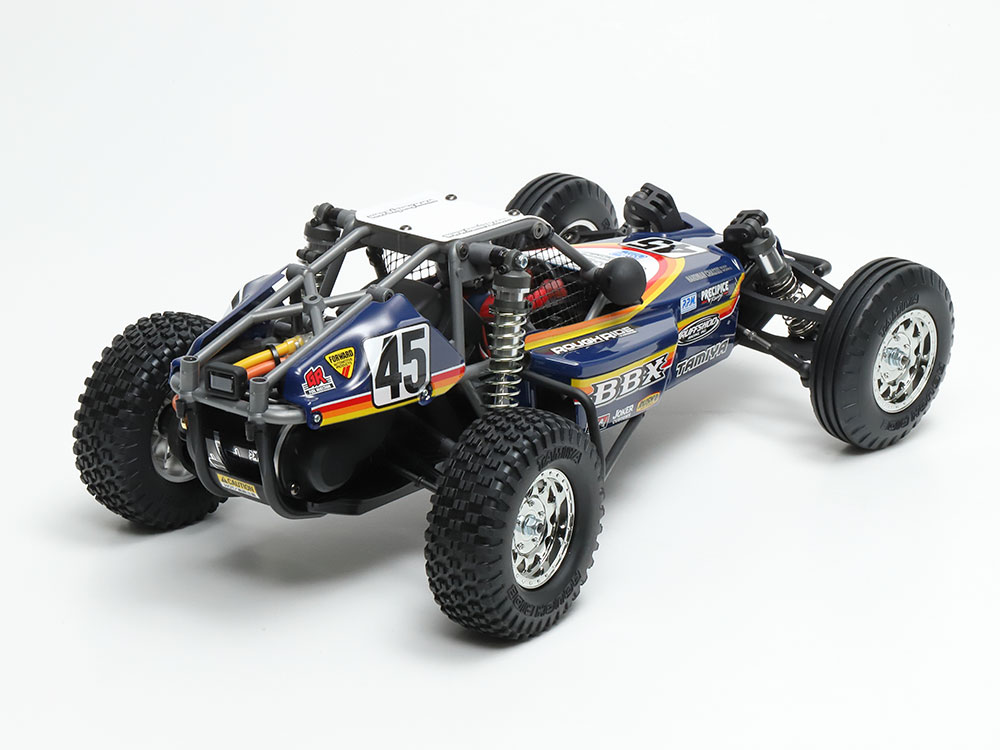
The six-piece panel arrangement is the heart of the BBX’s appearance. A long nose, roll cage, driver figure and nets make the car rewarding to finish, and the light pods create an optional route to illuminated detail. LEDs are an additional purchase, not a stock electronics feature of an unequipped kit. A display spare tire visible in some coverage should likewise not be treated as evidence that a running spare-wheel package is included.
Plan paint and decal work around panel access. Test the panels on their mounts before final decoration, keep fastening points clean and do not make battery access dependent on removing every piece you just finished. Tamiya describes the nose cowl and stopper pin used for battery access and the screws that release the rear cage section for motor service. Those are practical operations to rehearse before arranging wiring around them.
At 414 mm long and 233 mm wide, the car is a substantial 1/10 build. A transport box should protect the external driver and cage details while supporting the chassis. The model’s scale appearance does not supply evidence about crash survival, so we avoid a durability score based on how convincing it looks. For someone who enjoys display as well as driving, there is value in completing the finish carefully and choosing running ground that does not immediately turn every session into a body-repair project.
Sources: Manufacturer ↗ · Manufacturer manual / specification ↗
Startup basket: BBX BB-01
Tower Hobbies lists the exact TAM58719 complete kit at $263.20 in the directly checked product data. This is a dated independent retailer reference, not manufacturer MSRP and not a full startup total. The exact Amazon listing is verified separately; any live offer belongs in the expiring commercial box. A directly accessible current US manufacturer price was unavailable during this research pass. The useful comparison therefore keeps the clearly labeled retailer kit reference beside the precise motor, servo, radio and power-equipment checklist rather than substituting an undefined completion allowance.
The essential completion basket adds motor with suitable shaft, ESC compatible with the motor and pack, radio and receiver, low-profile servo, battery, charger, transmitter cells, appropriate paint and assembly tools. The available evidence does not price that precise set of components together, so there is no honest numerical startup subtotal to print. Obtain prices for the parts you intend to fit and record which tools and batteries you already own.
This matters more than on a kit with a supplied silver-can motor. The BBX lets you avoid paying for a motor you intend to replace, but it also places that selection on your own budget. A high-priced servo that fails the height requirement or a motor that fails the shaft requirement has no completion value. I would keep optional LEDs and cosmetic parts outside the initial comparison, then decide whether the car’s mechanical detail justifies the whole basket. If the total surprises you, the Fighter NXGEN is a useful less-involved complete-kit comparison.
| Item | Included / extra | Price basis |
|---|---|---|
| Reviewed vehicle | Kit/car only | $263.20 · stated dated reference |
| Motor | 540-size with usable shaft over 10.5 mm · sold separately | Included/extra as described |
| ESC | Sold separately · match chosen motor and pack | Confirm regional box; price any missing controller separately |
| Radio / servo | 2-channel radio/receiver + LOW-PROFILE servo · extra | Extra; quote exact components |
| Drive power | Compatible drive pack and charger · extra | Extra; quote exact pack and charger |
| Tools / finishing / transmitter cells | As required by exact manuals | Price required items separately |
Sources: Manufacturer ↗ · Manufacturer manual / specification ↗ · Retailer price reference ↗
Real alternatives: BBX BB-01
The Fighter NXGEN DT-04 offers a similar single-seater visual theme with a more straightforward beginner brief, a supplied 540 motor and white molded panels. It is a complete body-inclusive kit, and the checked US package includes an ESC. Its oil dampers and selectable wheelbases provide meaningful equipment without requiring the BBX’s exact ball-differential project. Compare the actual regional boxes and quote both completion baskets rather than assuming the lower kit price tells the whole story.
The Frog re-release appeals to a buyer who wants unusual Tamiya engineering in a deliberately historical form. Its space frame, inboard front springs and rear trailing arms create a different workbench experience. It includes a motor but has its own regional ESC question. Choose it when the old Frog identity is the desired object. The BBX is stronger as a modern scale-buggy build, not because we have proved that it drives faster or survives more impacts.
For someone who wants to drive immediately rather than finish panels and install electronics, a complete Losi Mini-B RTR buggy is a smaller-scale buying route to investigate in its exact current variant. Establish local parts support and the required battery package before comparing totals. I would never compare the BBX only against a bare race chassis. The alternative needs to be a whole car or body-inclusive kit with its completion requirements exposed. That keeps the choice about the ownership experience you are actually purchasing.
Sources: Manufacturer ↗ · Manufacturer manual / specification ↗
Buying verdict: BBX BB-01
The BBX is persuasive when the goal is a scale buggy that is interesting to assemble and understand. Its panels, cage, ball differential, supplied bearings, aluminum dampers and accessible motor section create a documented package with more substance than a nostalgic silhouette alone. The main cautions are the long completion list, low-profile servo fit and the unusual motor-shaft requirement. Those are genuine purchase decisions to settle before ordering.
The five editorial categories assess build substance, scale presentation, documented running hardware, service access and completion value for an experienced modeler. They do not claim measured handling, speed, durability or reliability. RC Driver’s build observations are credited as somebody else’s work, and the API’s differential error is not repeated as engineering fact. That separation is particularly important for a kit whose final performance depends on the electronics supplied by its owner.
I would choose the BBX for the builder who looks forward to the suspension and differential stages as much as painting the figure. I would complete a tidy conservative system, preserve a standard setup record and enjoy the car before turning it into an expensive power experiment. I would skip it when the immediate need is a ready-running car or a locally specified competition platform. On its own terms it is a convincing modern Tamiya project, provided the full purchase basket matches the enthusiasm that its appearance inspires.
Know exactly what you’re ordering.
Published manufacturer specifications for model 58719. Conflicting figures are flagged rather than silently corrected.
| Exact model / SKU | Tamiya 58719 |
|---|---|
| Amazon ASIN | B0C2P5FWPH · API verified |
| Scale / drivetrain | 1/10 · RWD |
| Purchase format | Body-inclusive assembly kit |
| Motor | 540-size with usable shaft over 10.5 mm · sold separately |
| Speed controller | Sold separately · match chosen motor and pack |
| Radio / steering servo | 2-channel radio/receiver + LOW-PROFILE servo · extra |
| Drive battery / charging | Compatible drive pack and charger · extra |
| Length / width / height | 414 × 233 × 136 mm |
| Wheelbase | 283 mm |
| Suspension | Front double wishbone, rear trailing arms; aluminum aeration oil dampers |
| Tires / wheels | Front ribbed 30/92 mm; rear square-spike 38/96 mm |
| Gear arrangement | 12.42:1 with supplied 18T pinion |
| Body | Six polycarbonate panels, cage, driver and nets; supplied |
| Specification caveat | API bullet incorrectly calls the differential oil-filled gear type; manufacturer specifies ball differential. Motor/ESC not included. |
Sources: Manufacturer ↗
The questions worth asking.
Does this exact model come ready to run?
No. It is a body-inclusive assembly kit. The body and chassis are supplied, but assembly, finishing and completion electronics remain part of the purchase.
What motor and controller are included?
540-size with usable shaft over 10.5 mm · sold separately. Sold separately · match chosen motor and pack. Confirm the offered regional box before buying replacement electronics.
What do I need for the first session?
2-channel radio/receiver + LOW-PROFILE servo · extra. Compatible drive pack and charger · extra. Transmitter cells, appropriate finishing materials and assembly tools also need checking.
What ground should I plan to use?
The BBX is an off-road buggy with ribbed front tires and square-spike rear tires. The manufacturer lists roughly 92 mm front and 96 mm rear diameter, which gives the tires a scale-buggy presence without making them crawler tires. Compact dirt and relatively even off-road practice space are sensible first choices. Tall grass, rock gardens and repeated large jumps should not be inferred from the body’s resemblance to a full-size desert racer.
Which specification differences should I check before ordering?
API bullet incorrectly calls the differential oil-filled gear type; manufacturer specifies ball differential. Motor/ESC not included.
Is the editorial rating a driving test or Amazon star rating?
Neither. It evaluates the documented complete purchase for experienced modeler wanting a modern scale buggy. Manufacturer facts, API identity and independent context are credited separately. No speed, grip, crash or reliability measurements are invented.
How this review was researched.
Manufacturer documentation establishes the mechanism and requirements. Amazon Creators API verifies the exact listing/part number and dated offer. RC Driver · Peter Vieira BBX build preview supplies attributed context; any modified build or sibling variant is explicitly distinguished in the article. API bullet incorrectly calls the differential oil-filled gear type; manufacturer specifies ball differential. Motor/ESC not included. The dated USD price reference is the directly verified exact-SKU Tower Hobbies Product/Offer, a retailer reference rather than manufacturer MSRP.
Research-led buying assessment using exact manufacturer documentation, verified Amazon identity and attributable independent coverage. We have not physically driven this model.
- Tamiya · exact model product/specification ↗Manufacturer · checked 13 Oct 2026
- Tamiya · assembly/body or regional specification documentation ↗Manufacturer manual / specification · checked 13 Oct 2026
- Amazon Creators API · exact ASIN B0C2P5FWPH ↗API product verification · checked 13 Oct 2026
- RC Driver · Peter Vieira BBX build preview ↗Independent coverage · checked 13 Oct 2026
- Tower Hobbies listed USD reference · exact kit only · retailer, not MSRP ↗Retailer price reference · checked 13 Oct 2026
13 October 2026: original complete-car research review, exact API identity, current evidence ledger and credited manufacturer media.
THE GARAGE EDITOR’S CALL
A considered purchase for experienced modeler wanting a modern scale buggy
I would choose the BBX for the builder who looks forward to the suspension and differential stages as much as painting the figure. I would complete a tidy conservative system, preserve a standard setup record and enjoy the car before turning it into an expensive power experiment. I would skip it when the immediate need is a ready-running car or a locally specified competition platform. On its own terms it is a convincing modern Tamiya project, provided the full purchase basket matches the enthusiasm that its appearance inspires.
Check exact car on Amazon ↗